Oura just made the biggest move in women's health tech this year. On February 25, 2026, they launched Oura Advisor -- a proprietary AI model built from scratch with webAI, designed to answer reproductive health questions inside the Oura app.[8] Combined with their existing temperature-based cycle tracking, clinical partnerships with Maven Clinic and Progyny, an $11 billion valuation, and a hardware base of millions of rings on millions of fingers, Oura is now the most serious player in the wearable-meets-women's-health space.
So the question every data-aware woman is asking right now: Is Oura Ring enough for real cycle tracking? Or is something still missing?
The honest answer is: both. Oura gets a lot right -- more than most people realize. The temperature data alone is genuinely valuable and backed by published research. But there is a fundamental gap between what Oura gives you (excellent raw signals and a chatbot to ask questions) and what your body actually needs you to understand (what those signals mean for you, in this phase, compared to your own cycle history). And that gap matters more than most women know, especially if you are dealing with work stress that is already disrupting your cycle.
Let me walk through what the research actually shows -- then where the real opportunity lies.
What Oura Actually Measures (And Why It Matters)
Before we talk about what is missing, let us give credit where it is due. Oura's hardware captures four continuous data streams that are genuinely relevant to menstrual cycle tracking:
- Nocturnal finger skin temperature. This is Oura's strongest suit for cycle tracking. Your skin temperature follows a biphasic pattern across your cycle -- lower in the follicular phase, higher in the luteal phase after ovulation. Oura captures this continuously while you sleep, which is far more reliable than waking up and taking an oral temperature with a thermometer.[9]
- Heart rate variability (HRV). Your autonomic nervous system shifts measurably across your cycle. Research shows HRV is typically higher in the follicular phase, reflecting greater parasympathetic tone, and decreases during the luteal phase as sympathetic activity increases.[1] This is a real signal -- but it is also heavily influenced by stress, sleep, alcohol, and exercise, which makes interpretation complicated without cycle-phase context.
- Resting heart rate. Resting heart rate tends to increase slightly in the luteal phase, reflecting progesterone's effects on cardiovascular dynamics.[2] Oura captures this continuously overnight.
- Sleep staging. Oura's multi-sensor sleep algorithm has been validated in research and captures REM, deep, and light sleep stages.[3] Sleep quality shifts across your cycle -- many women experience lighter, more disrupted sleep in the late luteal phase -- and tracking this matters.[10]
These are not gimmicks. These are real physiological signals that change across your menstrual cycle, and Oura captures them passively -- you just wear the ring to bed. That alone puts Oura ahead of app-only trackers that rely entirely on self-reported symptoms.
The Research: How Accurate Is Oura for Cycle Tracking?
A 2019 pilot study published in BMC Women's Health tested Oura's nocturnal finger skin temperature against urine-confirmed ovulation and menstruation diaries in 22 women. The results were promising: the best-performing algorithm detected ovulation with 83.3% sensitivity within the fertile window, and detected menstruation onset with 72 to 87% sensitivity depending on the window size. The mean offset was less than one day for both predictions.[4]
A follow-up study in 2022, published in the International Journal of Women's Health, tracked sleep, temperature, heart rate, and daily symptoms across the menstrual cycle using the Oura Ring in healthy women. It confirmed that nocturnal temperature, heart rate, and respiratory rate all showed significant variation across cycle phases -- meaning the data Oura collects is genuinely capturing real physiological changes, not noise.[5]
Separately, a 2021 study in the Journal of Medical Internet Research compared wrist skin temperature (from the Ava bracelet, a different wearable) against traditional basal body temperature for ovulation detection, finding comparable diagnostic accuracy -- further validating that continuous wearable temperature monitoring is a legitimate approach to cycle tracking.[6]
The bottom line on accuracy: Oura's temperature data is among the best continuous cycle tracking signals available in a consumer wearable. The research is real. The data is real. If you are choosing between Oura and manually taking your temperature every morning, Oura wins on consistency, convenience, and data density. The question is not whether the data is good. The question is what happens after you have the data.
What Oura's AI Advisor Does
The February 2026 launch of Oura Advisor is significant. Built on a proprietary LLM developed from scratch with webAI (not a fine-tuned GPT), hosted entirely on Oura's own infrastructure, and trained on medical research reviewed by board-certified clinicians, it represents a genuine investment in AI-powered health intelligence.[8] Here is what it adds to the Oura experience:
- Ask-and-answer format. You can type questions about your cycle, your symptoms, or reproductive health topics, and get answers from a model trained specifically on women's health content.
- Clinical partnership backing. Oura's relationships with Maven Clinic (virtual OB/GYN and family planning), Midi Health (menopause care), and Progyny (fertility benefits) suggest the AI model has access to clinically reviewed content.
- Contextual to your Oura data. The AI can reference your own Oura data when answering questions -- your temperature trends, sleep patterns, HRV shifts.
- Privacy-first architecture. Conversations are never shared or sold, and Oura stores user "Memories" that are individually deletable -- a strong trust play for sensitive health data.
This is a meaningful step forward from the previous experience, where Oura showed you graphs and left interpretation entirely up to you (or your Google search). Now there is an intelligence layer. But it is a specific kind of intelligence layer, and understanding what kind matters.
AI chatbot — you ask, it answers
Proactive — alerts you first
Source: BaRa Health
The Gap: What Oura's AI Still Cannot Do
Here is where it gets important. Oura's AI Advisor is a well-built, domain-specific chatbot backed by clinical partnerships and proprietary infrastructure. Oura tracks your data well. It shows you your trends over time. That is valuable. But there is a fundamental difference between showing you a 12-week trend line and giving you the phase-aware, cycle-compared intelligence that actually changes behavior.
Here are the specific gaps:
1. Trend line without phase context
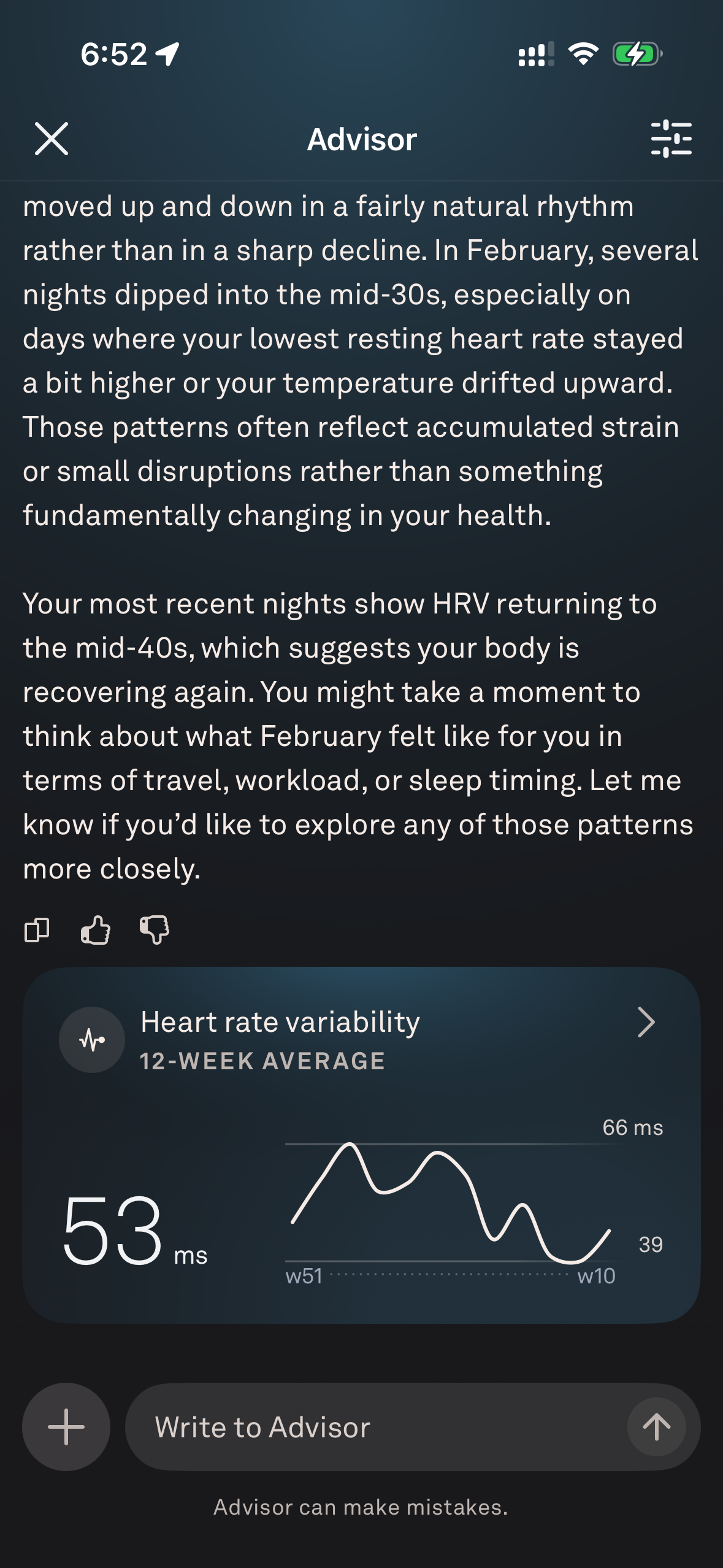
Oura shows you a 12-week HRV trend -- you can see the dips into the mid-30s, the recoveries to the mid-40s and 50s, the overall average. This is useful data. But that trend line does not overlay your cycle phases. It does not show you where in your cycle each dip happened. It does not compare this luteal phase's HRV to your last three luteal phases.
This matters because research on HRV across the menstrual cycle consistently shows that autonomic nervous system function varies significantly between cycle phases, with reduced vagal tone during the luteal phase being a normal physiological response.[1] A dip in your HRV during the luteal phase might be perfectly normal for you, in that phase. But without phase-level comparison, the same dip could look concerning -- or, worse, a meaningful deviation could get lost in the noise of normal cyclic variation.
A 2015 study documented that HRV parameters show significant variation between follicular and luteal phases, with the luteal phase showing markers of increased sympathetic and decreased parasympathetic activity.[2] The data is clear: your body operates differently in different phases. The intelligence gap is not that Oura fails to track your data -- it does that well. The gap is that it does not compare this luteal phase to your last three luteal phases. It does not tell you "your HRV in this luteal phase is 9ms below your luteal average from the past four cycles." That phase-to-phase comparison across cycles is where the real clinical signal lives.
2. No work-stress context
Oura knows your temperature, your HRV, and your sleep. It does not know that you had a product launch last week, that you have been in back-to-back meetings for three days, or that you skipped lunch twice because of a board presentation. But as we explored in our guide on how work stress disrupts your period, your professional context is often the most important variable in understanding why your cycle data looks the way it does.
An AI that answers reproductive health questions without knowing about the 60-hour work week that preceded your temperature shift is giving you incomplete answers. It is like a doctor who looks at your blood work but does not ask about your life.
3. Single-device, single-data-type limitation
Oura's AI only sees Oura data. If you also wear an Apple Watch during the day, if your gym uses a Whoop strap for workout tracking, or if you have done bloodwork recently -- that data lives in separate silos. And the silo problem goes well beyond other wearables:
- Blood tests. Hormone panels (estradiol, progesterone, FSH, LH), thyroid panels (TSH, T3, T4), metabolic panels -- these are some of the most important data points for understanding your cycle health. Oura does not even have a place to upload blood results. Your lab data sits in a patient portal you check once, disconnected from the wearable data on your finger.
- DEXA scans. Body composition and bone density data matters for women's health, especially if you are dealing with prolonged anovulation or planning for perimenopause. This data has no home in Oura's ecosystem.
- Genetic data. If you have done 23andMe, or if you have genetic data relevant to MTHFR, COMT, or other variants that affect hormonal metabolism -- Oura cannot incorporate it.
- Other lab results. Vitamin D levels, iron panels, inflammatory markers -- the data that a functional medicine doctor would want to see alongside your cycle data does not connect to Oura.
The most complete picture of your health comes from combining multiple data sources -- daytime activity, nighttime recovery, cycle data, work patterns, and clinical lab results. Oura's intelligence layer is locked inside Oura's ecosystem, and their current value proposition does not provide enough ROI for users to want Oura to be the hub for all of their health data. Users have data from many different vendors. Connecting it requires a platform built specifically as that cross-vendor intelligence layer.
4. Reactive, not proactive
Oura's AI Advisor waits for you to ask a question. A health agent monitors your data continuously and surfaces patterns before you notice them. The difference matters. By the time you think to ask "why is my period late?", the cortisol cascade that caused it may have started two weeks ago. A proactive system would have flagged the HRV decline during your luteal phase, compared it to your historical baseline, noticed it correlated with a heavy work sprint, and suggested a recovery protocol -- all before your period went off schedule.
5. The UX and behavior gap
Here is a gap that is less about technology and more about human behavior. Oura's AI Advisor lives on a secondary tab inside the Oura app. It is not the first thing you see when you open the app. You have to navigate to it, think of a question, type it out, and wait for a response. That is a high-friction interaction for something that should be seamlessly integrated into your daily health awareness.
The reality is that when people have a health question today, they already have a preferred AI they turn to. ChatGPT alone processes approximately 230 million messages per week.[11] Users go to the AI they already trust -- whether that is ChatGPT, Claude, or Google -- not to a buried feature in a health app they open to check their sleep score. The user behavior pattern is clear: people do not navigate to page two of a niche app to ask health questions. They ask the AI they are already talking to.
This is a positioning opportunity that matters. A health intelligence layer should meet you where you are -- proactively surfacing insights, integrating into the tools you already use, and reducing friction to zero. Not waiting on page two for you to find it.
6. No adaptive protocols
Even with the new AI Advisor, Oura does not generate personalized action plans that change based on where you are in your cycle and what your recent data trends show. It provides insights. It answers questions. But it does not say: "You are entering your luteal phase, your HRV has been trending down for three days, and your calendar shows a heavy meeting week ahead -- here is what to adjust in your sleep, exercise, and nutrition this week to protect your cycle." That kind of phase-aware, context-aware, adaptive protocol is what distinguishes a health agent from a health dashboard.
Oura vs. Health Agent: Feature Comparison
| Capability | Oura Ring + AI Advisor | Health Agent (BaRa) |
|---|---|---|
| Continuous temperature tracking | Yes -- validated | Via Oura/device |
| HRV monitoring | Yes | Via Oura/device |
| Sleep staging | Yes -- validated | Via Oura/device |
| AI-powered Q&A | Yes -- proprietary LLM | Yes |
| Phase-by-phase comparison across cycles | No -- shows trend, not phase comparison | Yes -- core feature |
| Work-stress context integration | No | Yes |
| Multi-device data (Apple Watch, Whoop, etc.) | No -- Oura only | Yes -- device-agnostic |
| Lab data integration (blood tests, DEXA, genetic) | No -- no upload capability | Yes |
| Proactive pattern detection | Limited -- reactive chat | Yes |
| Adaptive protocols (what to do differently) | No | Yes |
| Meets you where you are (low friction) | Partial -- buried in 2nd tab | Yes -- proactive alerts |
| Clinical partnerships | Yes -- Maven, Midi, Progyny | Building |
Source: BaRa Health
What This Means for You
If you own an Oura Ring, keep wearing it. The hardware is excellent. The data it captures -- temperature, HRV, sleep, heart rate -- is real, research-validated, and genuinely useful for understanding your cycle. The new AI Advisor is a step forward from staring at graphs and trying to interpret them yourself.
But if you are a woman who:
- Has a demanding career and suspects work stress is affecting your cycle
- Wants to know whether your luteal-phase symptoms are normal for you or a sign something is off
- Uses multiple devices or has lab data (blood tests, DEXA, genetic results) and wants them connected to your cycle data
- Needs actionable protocols, not just data dashboards or a chatbot tucked away on a secondary tab
- Is thinking about fertility planning and wants to understand your cycle in the context of your entire life -- not just your ring data
...then you need an intelligence layer on top of Oura's data. Not instead of Oura. On top of it.
The real question is not "which tool?" It is "which layer does each tool serve?" Oura is the data layer -- it captures the signals, and it does that exceptionally well. A health agent is the intelligence layer -- it reads those signals in cycle-phase context, compares them to your own history across cycles, integrates data from your labs and your calendar, and tells you what to actually do differently. You need both. The data without phase-aware interpretation is incomplete. The interpretation without data is guessing.
The Comparison That Actually Matters: You vs. You
This is the point worth repeating, because it is the thing nobody in this space is talking about clearly enough.
What matters is not where you fall on a bell curve, or even where your 12-week trend line sits. What matters is how this cycle phase compares to your own previous identical phases. Research consistently demonstrates significant inter-individual variation in menstrual cycle physiology -- your "normal" HRV, your "normal" temperature shift, your "normal" luteal-phase sleep pattern are unique to you.[12]
A recent analysis of menstrual tracking technologies in Fertility and Sterility underscored this point: the clinical utility of cycle tracking data depends heavily on the quality of longitudinal comparison and the context in which data is interpreted.[7]
If your luteal-phase HRV is 42ms and your personal luteal-phase average across the last four cycles is 44ms, you are probably fine. But if your luteal-phase average is 51ms and this cycle it is 42ms, that is a 17% deviation -- and it probably correlates with something in your life (a work sprint, poor sleep, travel, illness) that your system should flag and respond to.
Oura shows you that your HRV is 42ms. Oura's AI Advisor might tell you that 42ms is in a reasonable range and suggest you prioritize rest. But neither tells you that your luteal-phase HRV has dropped 17% compared to your own baseline for this specific phase -- and that the drop correlates with the week your calendar shows 38 hours of meetings. That is the intelligence gap. And that phase-by-phase, cycle-by-cycle comparison is exactly what BaRa is built to do. We do not replace your wearable. We make your wearable data mean something.
Frequently Asked Questions
How accurate is Oura Ring for tracking your menstrual cycle?
Research published in BMC Women's Health found that Oura's nocturnal finger skin temperature detected ovulation with 83.3% sensitivity within the fertile window, and menstruation with 72-87% sensitivity.[4] This makes Oura one of the more accurate consumer wearables for cycle tracking, though individual accuracy varies based on cycle regularity, stress, sleep, and other factors.
What is the difference between Oura's AI Advisor and a health agent?
Oura's AI Advisor is a chatbot on a secondary tab in the app: you navigate to it, ask a question, and get an answer based on its training data and your Oura metrics. A health agent is proactive: it continuously monitors your data, compares patterns across cycles and phases, integrates data from multiple sources (wearables, labs, calendar), and alerts you to deviations before you even notice them. The key difference is reactive (you ask, it answers) vs. proactive (it monitors, it alerts, it adapts your protocol).
Can I use Oura Ring with BaRa?
Yes. BaRa is device-agnostic -- it works as an intelligence layer on top of whatever wearable you already use, including Oura Ring, Apple Watch, and Whoop. It also integrates blood test results, DEXA scans, and genetic data. Oura provides excellent raw data. BaRa adds contextual intelligence: comparing your current cycle to your own history, factoring in work stress patterns, and generating adaptive protocols that Oura's native app does not provide.
Is Oura Ring worth it for women's health tracking?
For the data alone, Oura is among the best consumer wearables for women. Its continuous temperature monitoring, sleep staging, and HRV tracking are research-validated. However, the data is only as valuable as the interpretation layer on top of it. If you are a high-achieving woman dealing with work stress, irregular cycles, or fertility planning, you likely need contextual intelligence that compares your data phase-by-phase against your own cycle history -- not just a trend line over time.
You already invested in the hardware. Now add the intelligence layer.
BaRa is an AI health agent that takes your Oura, Apple Watch, or Whoop data -- plus your labs, your calendar, and your life context -- and compares you to yourself. Phase by phase, cycle by cycle. No more guessing whether your numbers are "normal." Know what they mean for you.
Join the Waitlist Starting at $12/month. $99/year for Pro.References
- Yazar S, Yazici M. "Impact of Menstrual Cycle on Cardiac Autonomic Function Assessed by Heart Rate Variability and Heart Rate Recovery." Medical Principles and Practice, 2016; 25(4). doi:10.1159/000444322
- Brar TK, et al. "Effect of Different Phases of Menstrual Cycle on Heart Rate Variability (HRV)." Journal of Clinical and Diagnostic Research, 2015; 9(10). doi:10.7860/jcdr/2015/13795.6592
- Altini M, Kinnunen H. "The Promise of Sleep: A Multi-Sensor Approach for Accurate Sleep Stage Detection Using the Oura Ring." Sensors, 2021; 21(13): 4302. doi:10.3390/s21134302
- Maijala A, Kinnunen H, Koskimaki H, et al. "Nocturnal finger skin temperature in menstrual cycle tracking: ambulatory pilot study using a wearable Oura ring." BMC Women's Health, 2019; 19(1). doi:10.1186/s12905-019-0844-9
- Alzueta E, de Zambotti M, Javitz H, et al. "Tracking Sleep, Temperature, Heart Rate, and Daily Symptoms Across the Menstrual Cycle with the Oura Ring in Healthy Women." International Journal of Women's Health, 2022; 14. doi:10.2147/ijwh.s341917
- Zhu TY, Rothenbuhler M, Hamvas G, et al. "The Accuracy of Wrist Skin Temperature in Detecting Ovulation Compared to Basal Body Temperature: Prospective Comparative Diagnostic Accuracy Study." Journal of Medical Internet Research, 2021; 23(6): e20710. doi:10.2196/20710
- Milad MP, Cromack A, Walter JR. "Menstrual tracking technologies and fertility: evaluating accuracy, utility, and impact on time to pregnancy." Fertility and Sterility, 2026. doi:10.1016/j.fertnstert.2026.02.027
- Oura. "Oura Launches AI-Powered Advisor for Reproductive Health." Oura Blog / T3 / TechCrunch, February 25, 2026. Proprietary LLM built with webAI, hosted on Oura infrastructure, reviewed by board-certified clinicians.
- Baker FC, Siboza F, Fuller A. "Temperature regulation in women: Effects of the menstrual cycle." Temperature, 2020; 7(3): 226-262. doi:10.1080/23328940.2020.1735927
- Baker FC, Driver HS. "Circadian rhythms, sleep, and the menstrual cycle." Sleep Medicine, 2007; 8(6): 613-622. doi:10.1016/j.sleep.2006.09.011
- Duarte F. "ChatGPT Statistics and User Numbers." Exploding Topics, February 2026. Reports approximately 400 million weekly active users and 230+ million messages per week.
- Fehring RJ, Schneider M, Raviele K. "Variability in the phases of the menstrual cycle." Journal of Obstetric, Gynecologic & Neonatal Nursing, 2006; 35(3): 376-384. doi:10.1111/j.1552-6909.2006.00051.x
What to Read Next
- Why Your Job Is Messing With Your Period -- The biological chain from your inbox to your missing period.
- What Your Declining HRV Is Actually Telling You -- A deep dive into the signal your wearable is already tracking.
- What Is a Health Agent? -- Why the future of women's health is not another tracking app or chatbot.